Acetal Enameled Wire: History, Properties and Applications
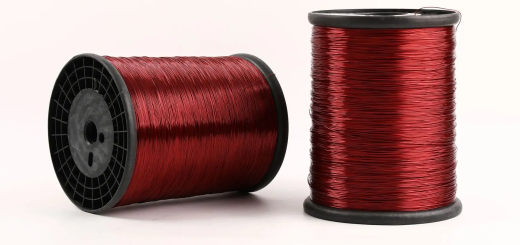
Acetal enameled wire is one of the world’s earliest varieties of development, 1930 has been put on the market by Germany, the United States respectively, the Soviet Union also developed quickly, there are two kinds of polyvinyl acetal and polyvinyl acetal, China also in the 1960s research success. The enameled wire although the low temperature level (105 ° C, 120 ° C), but because of its excellent resistance to high temperature hydrolysis performance and widely used in oil-immersed transformers, this feature has been notarized by the world, China still has a small amount of production, especially acetal enameled flat wire used to make displacement wire, used in large transformers.
Process characteristics of acetal enameled wire acetal wire
Acetal varnish is divided into two types of varnish: large varnish has a greater viscosity than various enameled wire varnishes and is suitable for coating in a vertical car using the mold method, while fine varnish has a small viscosity and is suitable for production in a horizontal enameling machine using the felt method. Over the years, the production practice of coating large lines of lacquer has created a lot of experience using the mold method, this method has many characteristics: 1. with the mold method of coating, when the mold aperture with the appropriate later, the thickness of the enameled wire layer can remain stable for a long time, without the need to use the felt method as often as the thickness adjustment. 2. can make the surface of the enameled wire to maintain a uniform and smooth, rarely appear not light, bubbles, particles and other defects. In the case of furnace temperature, speed and copper wire quality is basically stable, it has a higher rate of positive than other types of enameled wire. 3. mold method of wire coating, the original paint can be used, the solid content of the coated wire can be increased, which can save solvent, but also reduce the process of adjusting paint. 4. mold after a period of time also need to be cleaned, but generally can maintain the field days. Compared with the felt in the use of days that is to be replaced, can reduce the change of felt when the waste silk, save the felt absorbed by the lacquer. 5. mold structure itself is simple, the cost is very low, a set of molds can be applied after seven, eight years or more and not damaged, while the annual consumption of felt in the enameled wire factory is considerable. Of course, in the production of large lines of acetal, such as small quantities, specifications, due to the replacement of the mold will bring some difficulties in production, which is also a practical problem.
Polyester enameled wire and acetal enameled wire in the transformer oil containing water was simulated aging test to 106 ~ 1100 aging 7 days as a cycle, the test results confirmed that polyester enameled wire in 12 cycles, the electrical properties significantly decreased, while the acetal line still maintains a better performance. The various enameled wire made according to the standard breakdown voltage of the grain line specimens, into the power 30 X 20 mm brass cylinder container, and add 1 ml of vacuum-dried transformer oil, in 1 ℃ after 500 hours of aging, the breakdown voltage of the enameled wire measured changes.
Characteristics and applications of acetal enameled wire acetal enameled wire
Acetal enameled wire is the first high-strength enameled wire with high mechanical strength, which can meet the requirements of the general high-speed automatic winding device for the strength of the enameled wire; in addition, its enamel film is soft and has good adhesion to the copper wire, so it can also meet the requirements of micro-motor end shaping. However, its most important feature is its excellent oil and thermal shock resistance.
In general, high-strength enameled wires have good oil resistance, but in oil-immersed transformers and oil-filled motors, where the enameled wire is immersed in high-temperature, closed oil for a long time, the oil resistance of different enameled wires is obviously different. From foreign reports, the United States in 1963, the 4th Insulating Materials Conference made such a conclusion: in all tests, whether or not with paper, polyvinyl enameled wire layer cracked, it is completely incompatible with the transformer oil system; on the contrary, acetal enameled wire and polyacrylic enameled wire (Loot) n after the test more comprehensive to maintain the original performance. From Japan’s 1973 report, 30 of the total number of enameled wire varieties acetal wire is mainly used in oil-immersed transformers, while polyacrylic acid is more successful in the E class motors and dry-type transformers have been widely used.