Nickel-Zinc Ferrite: Properties and High-Frequency Uses
Ni-Zn ferrite is a soft magnetic material, made of Ni-Zn mixed oxide, Fe2O3 and other auxiliary materials through a series of processes. It has the characteristics of high permeability, low hysteresis loss, low eddy current loss, good thermal stability and dimensional stability, so it is widely used in electronics, communication, electric power and other fields.
Due to its high frequency, wide frequency, high impedance and low loss characteristics, Ni-Zn ferrite has received more and more attention in recent years and become the most widely used soft magnetic ferrite material with excellent performance in the high frequency range (1-100MHz). Many domestic manufacturers have been producing Ni-Zn ferrite materials and components, but compared to MnZn soft magnetic ferrite, Ni-Zn ferrite is relatively slow to develop in China, and the scale is also much smaller than MnZn soft magnetic ferrite. Ni-Zn ferrite by permeability classification Ni-Zn ferrite material permeability ranging from 15-2000 are used, commonly used materials permeability between 100-1000. According to the classification of magnetic permeability, they can be divided into high permeability materials, conventional materials and low permeability materials.
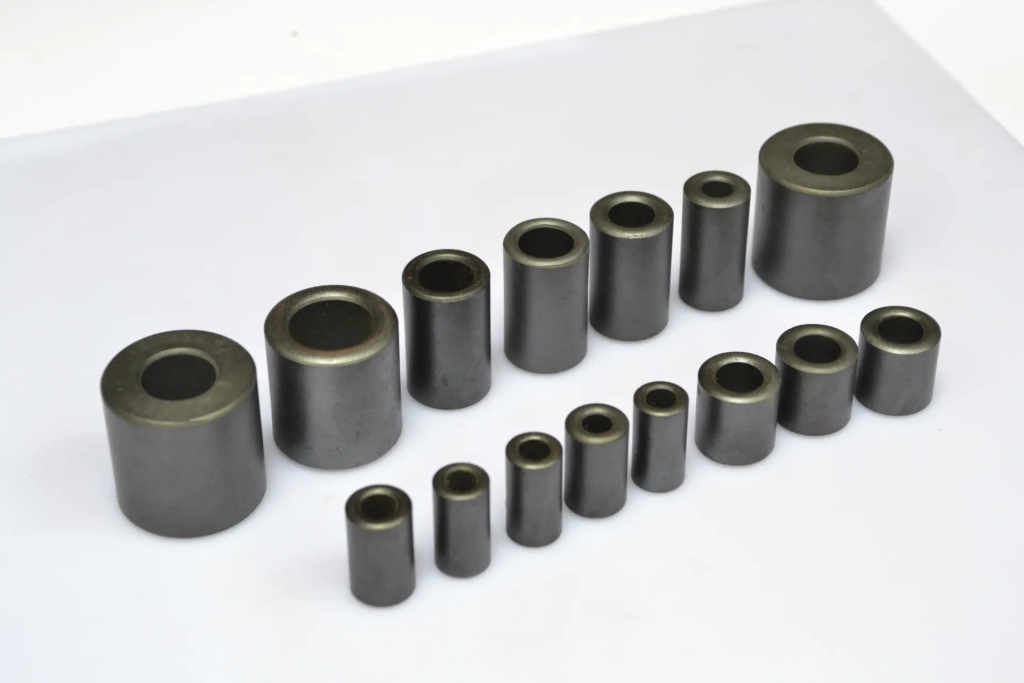
The magnetic permeability above 1000 is customarily called high permeability material, the magnetic permeability between 200-1000 is called conventional material, and the magnetic permeability below 200 is called low permeability material. In general, the lower the magnetic permeability of the material, the wider the applicable frequency range; the higher the magnetic permeability of the material, the narrower the applicable frequency range. For example: μi=15 material is suitable for more than 100MHz, while μi=1500 material is only suitable for less than 1MHz.
The permeability of Ni-Zn ferrite is usually between 1000 and 15000, which is lower than that of ferrite, but has lower hysteresis loss and eddy current loss. This makes Ni-Zn ferrite widely used in high frequency electronic components, such as high frequency transformers, filters, common mode inductors, antennas, etc.
The thermal and dimensional stability of Ni-Zn ferrite is also one of its important features. Under high temperature environment, the permeability and hysteresis loss of Ni-Zn ferrite change little, so it can be used in electronic components under high temperature environment. In addition, the dimensional stability of Ni-Zn ferrite is also better, and it is less prone to deformation and thermal expansion, so it is widely used in electronic components that require high precision.
In conclusion, Ni-Zn ferrite, as a commonly used soft magnetic material, has a variety of excellent properties and is widely used in the fields of electronics, communications, and electric power.