Flat Wire Motor Technology: Design Trends and Benefits
From a long-term perspective, miniaturization, high-speed will be the main development trend of new energy vehicle motors, and miniaturization will inevitably require a substantial increase in motor power density, from the point of view of technical requirements, the “13th Five-Year Plan” proposes that new energy vehicle drive motors to reach a peak power density of 4kW/kg, while the current data only reaches 3.2-3.3kW/kg.
Flat wire winding motor in the Chevrolet volt2, Nissan electric car, Toyota’s fourth-generation Prius and other foreign manufacturers have been successfully applied, is China’s next generation of new energy vehicle motor development trend is inevitable, at present, including BYD, SAIC, BAIC, JingJin new energy, including the main engine manufacturers and motor manufacturers have carried out the corresponding research.
Before 2020, the substitution of flat-wire motors for round motors is still not obvious enough. Thanks to the advantages of flat-wire motor’s small size, flat-wire motor will be prioritized for large-scale application in hybrid models, especially plug-in models. However, the domestic policy and market factors, plug-in models accounted for a relatively low. As for the pure electric field, at present, only one model of SAIC Rongwei ERX5 is assembled with flat-wire motor, which is less applied.
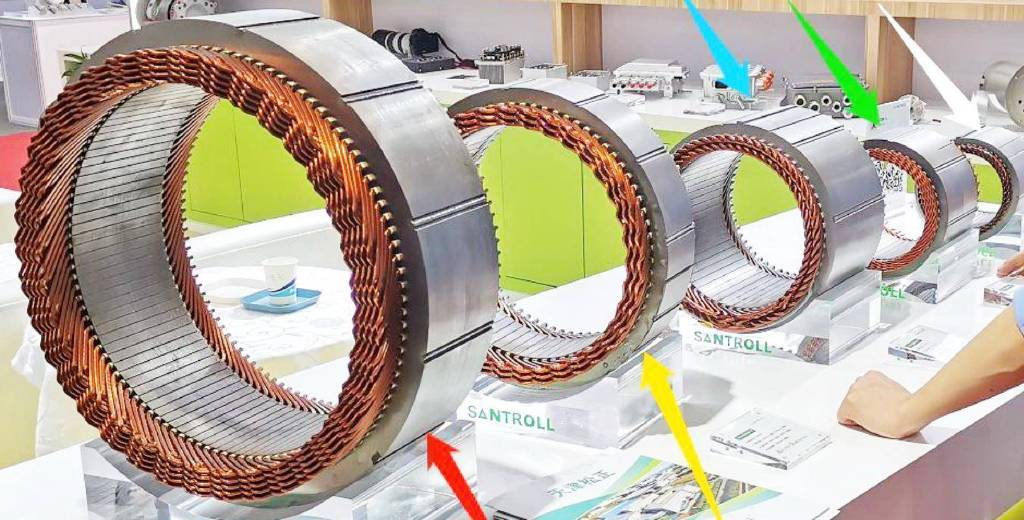
Hairpin motor stator main production process, wire molding and paper molding and paper insertion, these two processes are synchronized. Into the stator of the insertion process, and then twisted line, twisted line after the completion of the welding process. After the welding is completed, the basic process of the motor stator is completed, followed by coating, and then performance testing and verification. This is the basic process, there are many details in the middle.
Flat wire motor production process: slot paper → manufacturing hairpin → wear hairpin → end ring shaping → end ring welding → connecting star point → insulation treatment at the welding place
Advantages of flat wire motor
1: the same power, smaller volume, less material, lower cost, or the same volume, slot fullness rate increase, power density increase. Round wire into flat wire, theoretically, under the premise of the space remains unchanged, flat wire motors can achieve 70% slot fullness, filled with copper can be increased by 20-30%, generating a stronger magnetic field strength, which in a way is equivalent to increase the power by 20-30%.
2: Better temperature performance. The internal gap becomes less, the contact area between flat wire and flat wire is large, better heat dissipation and heat conduction; the contact between the winding and core slot is better, better heat conduction; and the motor is very sensitive to heat dissipation and temperature, better heat dissipation, the performance will be improved. Some people through the temperature field simulation, concluded that the same design of flat copper wire motor winding temperature rise is 10% lower than round copper wire motor.
3: Lower electromagnetic noise. Flat wire motor wire stress is relatively large, rigidity is relatively large, the armature has a better stiffness, the armature noise has a suppression effect; you can take a relatively small slot size, effectively reduce the cogging torque, and further reduce the electromagnetic noise of the motor.
4: Short end, save copper, improve efficiency. Traditional round wire motors, due to process problems, its end is generally left longer, otherwise it is easy to damage the copper wire in the process. For flat wire motors, because the wires are hard wires, you can make the end smaller in the process, compared with round wire motors to reduce the end size by 20%, the space is further reduced, you can further reduce the size of the system, to achieve miniaturization and lightweight.
5: The highest efficiency point of flat wire motor is not necessarily much higher than round wire, but the high efficiency zone can be further broadened.