Continuous Wave Winding: Structure and Motor Winding Features
Wave winding is a type of winding in which the synthetic pitch is equal to an integer. In winding this winding, the two commutators connected to the two outgoing ends of each element are far apart, and the two elements are connected in series to form a wave shape, so it is called a wave winding.
In the single wave winding, if the synthesized pitch is taken as a negative sign, it is called the left winding; if it is taken as a positive sign, it is called the right winding. Right winding end connection part of the cross, and slightly longer than the left winding end connection line, so the wave winding commonly used left winding.
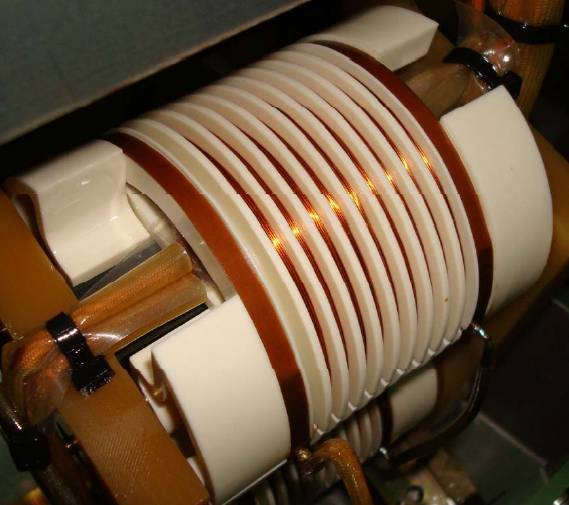
Wave winding is characterized by two connected single-turn coils into a wave shape forward, and stacked winding, they are in the shape of the coil ends and the order of connection between the coils is different. Wave winding is connected to the law: all the same pole (such as N pole) belongs to the same phase of the coil according to the wave shape in series, forming a group; and then where the other pole (such as S pole) belongs to the same phase of the coil according to the wave shape in series, forming another group; and finally the two large groups of coils according to the need for series or parallel, constituting a phase of the winding.
By the single stack winding and single wave winding connection law, there is no substantial difference between the two. For single stack winding, when the motor pole number is greater than 1, its parallel branch more; For single wave winding, its parallel branch number constant equal to 1, and the main pole pole number has nothing to do.
In this way, in the number of components and conductor cross-sectional area of the same case, the single stack winding of each circuit of the number of components is less branch potential is lower, but allows through the total armature current is larger, suitable for low voltage, high current DC motor, while the single wave winding of each circuit of the number of components is more, the branch potential is higher, but allows through the armature current is smaller, suitable for high-voltage, small-current DC motors.


