Single-Phase Transformers: Structure, Function and Common Uses
A single-phase transformer is an electrical device used to change the AC voltage and consists of a magnetic core and windings. It transfers voltage from one circuit to another while keeping the frequency constant.
Following are the details of single phase transformer:
- Core: The core of a single-phase transformer is usually made of an iron core or silicon steel sheet having high permeability characteristics. The purpose of the core is to provide a low reluctance path so that the flux coils (windings) can effectively transfer the magnetic field.
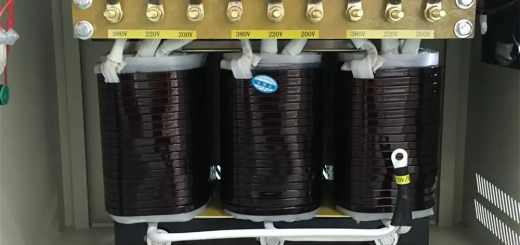
- Windings: A single-phase transformer consists of two windings, i.e., the main winding and the secondary winding. The main winding is connected to the input power supply and the secondary winding is connected to the output load. The primary and secondary windings are connected to each other by magnetic coupling. The current in the main winding generates a magnetic field, which is transferred to the secondary winding through magnetic coupling, thus generating an induced electromotive force in the secondary winding.
- Input and Output Voltages: The input voltage of the primary winding is called the primary side voltage and is usually the standard voltage of the supply network. The output voltage of the secondary winding is called the secondary side voltage, which can be stepped up or down according to the needs of the transformer.
Transformer ratio: The transformer’s transformer ratio defines the proportional relationship between the primary and secondary voltages. The transformation ratio is equal to the secondary voltage divided by the primary voltage.
Transformer ratio = secondary voltage / primary voltage
The transformation ratio determines the step-up or step-down function of the transformer.
- Flux coupling: Flux coupling is the coupling effect between the main winding and the secondary winding produced by the magnetic field. When the current in the main winding changes, the resulting magnetic field passes through the core and is transferred to the secondary winding through magnetic coupling. This change in magnetic field produces an induced electromotive force in the secondary winding, which results in a change in voltage.
- Iron and Copper Losses: There are two main types of energy losses in a single-phase transformer, i.e. iron losses and copper losses. Iron losses are energy losses due to hysteresis and eddy currents in the iron core. Copper losses are energy losses due to resistance in the primary and secondary windings. These losses are released in the form of heat and therefore require a proper cooling system to dissipate the heat.
- Efficiency The efficiency of a transformer is defined as the ratio of output power to input power. Efficiency is usually as high as 90% or more, depending on the design of the transformer and the load conditions. 1.
- insulation: Insulation is very important due to the high voltages and currents present in a transformer. Insulating materials are used to isolate the windings and core to prevent current leakage and arcing faults.
Single-phase transformers are common equipment in power systems for transmission, distribution and various applications. Single-phase transformers are used in many applications because of their high efficiency, reliability, and simplicity of operation.