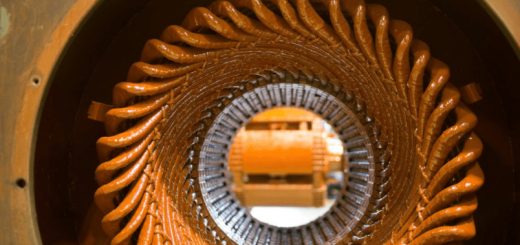
Motor Stator Core: Magnetic Circuit Function and Losses
The stator core is an important part of the stator and the main component of the magnetic circuit of the motor. It is composed of fan-shaped piece, ventilation slot piece, positioning bar, upper and lower teeth pressure plate, tension bolt and pallet and other parts. The stator core is made of silicon steel sheet punched into a fan-shaped sheet stacked on the positioning bars, the positioning bars are welded to the base ring plate through the pallet, and the core is pressed into a whole by the upper and lower teeth pressure plate with tension bolts.

The material for punching the core of hydro generator is usually silicon steel sheet. The silicon steel sheet is a thin steel sheet with low carbon content. In order to obtain a feasible low hysteresis loss. Production is carried out under special controlled conditions. Generally pure iron is not suitable for use in alternating magnetic fields, mainly because of its small resistivity, which causes large eddy current losses. When silicon is added, the resistivity is increased because silicon and iron form a solid-solution type alloy. The increase in resistivity is used by silicon steel sheets to reduce eddy current losses due to the thickness direction. Eddy current loss is proportional to the thickness of the silicon steel sheet, which is usually 0.35 to 0.5mm thick for cores.
Fan punch
When designing a fan punch. The number of slots on each punching sheet must be integer, and the seam between the sheets should not be on the teeth. To avoid overlapping of the edges of adjacent fan punching sheets, a gap of 0.2~0.25mm should be left at the seam. In addition, in order to prevent the bottom of the slot at the seam from damaging the insulation of the winding, the bottom of the slot at the right angle of the seam should be punched into a 30° chamfer 2mm.
To sum up:
1) Good magnetic conductivity and low loss. Usually the iron core of large motors should do iron loss test, measured by the test than the loss value should not be greater than the silicon steel used in the frequency of 50Hz, flux density of 1T, 1.3 times the standard loss per kilogram of silicon steel. After the temperature of the core is stabilized, the maximum temperature rise should be less than 25K, and the temperature difference between different parts should be less than 15K. If the temperature rise is large, there may be a local short circuit.
2) Good stiffness and small vibration. For the core of the installation pressure fastening, should keep a certain pressure between the punching piece, usually 1.5 ~ 2.0MPa for large motors and 0.7 ~ 1.0MPa for small motors.
3) Good ventilation and cooling effect in the structure arrangement. In large and medium-sized motors with radial ventilation, in order to make the cooling gas can blow the middle part of the core, so that the core to obtain good cooling effect, the core is divided into many stacked segments along the axial direction. Each segment is 30~60mm long, and the segment is equipped with 6~10mm wide ventilation slot piece to form a radial ventilation trench.
4) The inner diameter and slot size of the core after stacking should meet the design accuracy requirements. Especially for micro special motors, in addition to the requirement of core tightening to prevent short circuit between punching pieces, it should also ensure that the slot indexing accuracy reaches the angular grading level, otherwise it will seriously affect the accuracy index of the motor.
In addition, there are some special requirements for the cores of large turbine generators and large hydro generators. For example, large turbine generator cores are usually equipped with a number of stepped stacked segments at both ends, and some also have narrow slots in the middle of the teeth of the stepped segments to reduce the additional loss generated by the axial component of the end leakage of magnetism. The large hydro generator should ensure the gap between the fractional cores, otherwise it will cause the core to vibrate when the motor is running.