Flat-Wire Motor Winding Types: Comparison and Analysis
Flat wire motor has the characteristics of high slot fullness, high heat dissipation efficiency and good NVH performance, in the stage of rapid development of new energy vehicles, flat wire motor technology is in line with the development trend of high performance, high efficiency and high power density of drive motors. Flat wire motor has the characteristics of high slot fullness, high heat dissipation efficiency and good NVH performance. In the stage of rapid development of new energy vehicles, flat wire motor technology is in line with the development trend of high-performance, high-efficiency and high-power density of drive motors.
The application of flat-wire motors in new energy vehicles began with the “Advanced Integrated Drive System (DOE)” project led by the U.S. Department of Energy, which uses three key technologies for motors, one is a five-phase winding, one is a double-V pole structure, and the other is a flat-wire motor. At the same time, the U.S. Department of Energy DOE released the electric vehicle 2025 development route planning map in 2017, which gives clear technical parameter requirements for the development goals of the three electric systems. Cost in 2025, the requirements of the electronic control in 2025 to reach 2.7 $ / kw, the motor needs to reach 3.3 $ / kw. In terms of power volume, the peak power volume density of the motor needs to be 50kW / L. The electric motor needs to be highly compact and compact, and the electric motor needs to be highly compact and compact, and the electric motor needs to be highly compact and compact.
EV motors need to be highly compact and lightweight, while also being subject to stringent efficiency and energy density requirements. For most motor manufacturers, the current need is to be able to develop flat line motor products that meet specific requirements, and the rigor and customization of the production steps are core issues that are difficult to overcome in the manufacturing process.
Unlike the manufacturing of industrial motors, electric vehicle drive motors must strictly control the stator and the materials, process parameters and test results related to its quality. Compared with industrial motors, EV motors usually have a much shorter production cycle, so their manufacturing process is relatively more complex. As a result, electric vehicle components require more flexible production equipment that can be switched to a new stator design or design as easily as possible.
The stator winding is the power heart of the drive motor for new energy vehicles, and usually refers to a symmetrical circuit connection loop consisting of multiple coils or coil sets through different winding methods. Under driving conditions, when external electrical energy is connected to the input terminals of the stator winding through the high-voltage wiring harness, the stator winding converts the incoming electrical energy into magnetic energy and stores it in the stator-rotor air gap, which is ultimately converted into mechanical energy to provide the driving force.
Hair pin / Hairpin winding
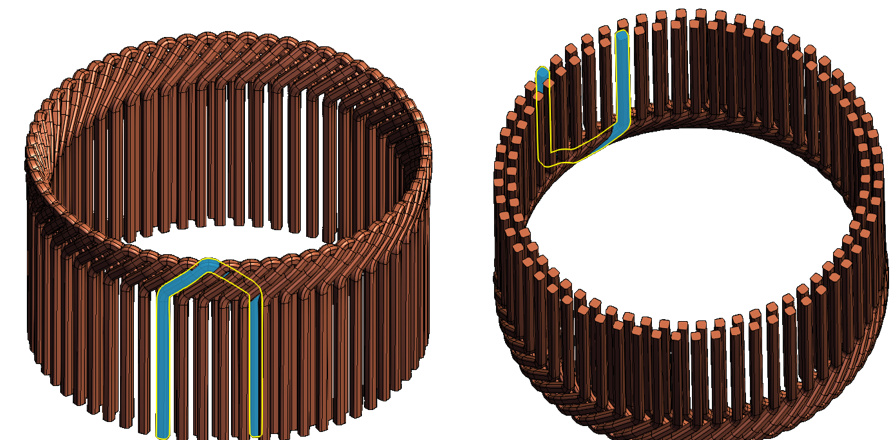
The Hairpin is the most common form of flat wire winding, also known as a hairpin winding due to the shape of the individual wires, which resemble hairpins. This type of winding is characterized by the fact that only one end needs to be soldered.
Hairpin winding process is the first flat wire winding pre-formed into a “hairpin” type structure, the whole axial assembly into the stator core slot.
Due to the axial embedded winding is not affected by the shape of the pole shoe, can greatly reduce the winding embedded assembly space and conductor gap, the slot full rate can reach about 70% (currently on the market has been batch production of Hairpin products, the highest slot full rate of 69%), Hairpin winding by virtue of its excellent power, torque and efficiency performance to rapidly occupy the mainstream technology market.
I-Pin Winding
The idea of I-Pin winding is that the flat wire conductor is not pre-formed, and the straight flat wire conductor is directly embedded in the core slot along the axial direction and needs to be welded under the head.
I-Pin biggest feature is the manufacturing process is simple, a word flat copper wire directly into the stator groove after twisting head welding, characterized by the end of both ends need to be welded.
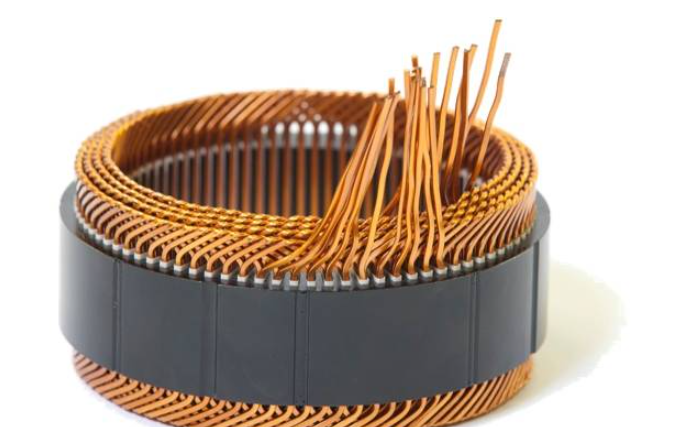
Flat wire continuous wave winding of the biggest advantage is the molding of the two ends of the end without welding, but because the winding type manufacturing process is still in the development stage, has not yet become mainstream.
Under the same performance conditions, the Hairpin can have a shorter end length compared to a distributed round wire winding, and a slightly longer end length compared to a wave winding.
For stator structures with a large number of slots, Hairpin is more difficult to exit the wire and welding process, while wave windings do not have the problem of end welds and are relatively more suitable for multi-slot stators.
Hairpin winding or I-pin winding, both in the structure and process manufacturability of each other have advantages and disadvantages, but its winding technology is the same way, are by improving the winding slot fullness to improve the power, torque and efficiency of the drive motor performance, used to meet the increasingly stringent technical requirements of the electric drive market, which is the essence of the development of the drive motor winding technology.


