Transformer Windings: Role, Polarity and Electrical Function
The main magnetic flux in the transformer core, the induced potential in the primary and secondary windings are alternating potentials and have no fixed polarity. The transformer winding polarity here refers to the relative polarity of the primary and secondary windings, that is, when one end of the primary winding has a positive potential at a certain instant, the secondary winding also has a positive value at the same moment. The potential, then the corresponding two ends are called the same polarity end of the transformer.
The polarity of the transformer winding is determined by the winding direction of the transformer winding, and when the winding direction changes, the polarity will also change. Polarity is one of the main conditions for transformers to operate in parallel. If the polarity is reversed, it will cause a short circuit and burn the transformer. This is the same as two batteries used in parallel, should connect the positive terminal and positive terminal, negative terminal and negative terminal, if the positive terminal and negative terminal are connected at the same time, the battery will be short-circuited and the battery will burn up soon.
The windings are usually divided into two types: layer and pie.
The wire in the winding is wound continuously along its axial arrangement, called layer winding. Generally, each layer of layer winding is like a cylinder, so the winding composed of two layers is called double cylinder type; the one composed of multiple layers is called multi-layer cylinder type.
The winding will wind the wire continuously along its radial direction to make a pie (segment), and then the winding arranged by many pie pieces along the axial direction is called pie winding. It includes continuous type, insert capacitor type and twist type.
Interlayer and pie windings are foil windings and spiral windings. Foil winding is also tubular, and the wire turns are wound continuously along the axial direction, generally one turn is one layer, so it can be layer winding. Spiral winding is generally one turn per disc, or two discs or four discs with one turn, each turn is wound continuously along the axial direction, but the form is composed of each disc, so it can be a disc winding.
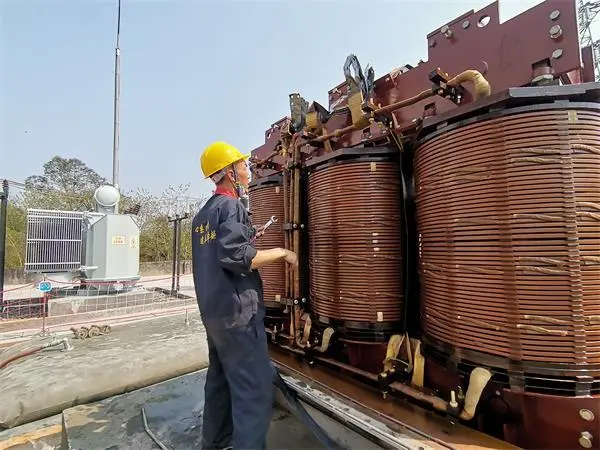
The winding is the circuit part of the transformer, made of surface insulated copper or aluminum wire winding, mounted on the core column of the transformer. The winding has a primary winding and a secondary winding, the primary winding is used for power input and the secondary winding is used for output. When the primary winding is passed through the alternating current, alternating magnetic flux is generated in the core accordingly. According to the principle of electromagnetic induction, the energy input from the primary winding is transferred through the core to the secondary (output) winding. Line losses in the transmission process. The winding should have sufficient insulation strength, mechanical strength and heat resistance.