Current Sensors: Function, Types and Electrical Applications
Current sensor, a detection device, can feel the information of the measured current, and is usually used to monitor the current changes in the power system. Current sensor can convert the current into voltage or electrical signal output, and can transform the information sensed by the detection into electrical signal or other required form of information output in accordance with certain rules to meet the requirements of information transmission, processing, storage, display, recording and control.
Current sensors, also known as magnetic sensors, can be used in household appliances, smart grid, electric vehicles, wind power generation, etc. Many magnetic sensors are used in our lives, such as computer hard drives, compasses, household appliances, etc.
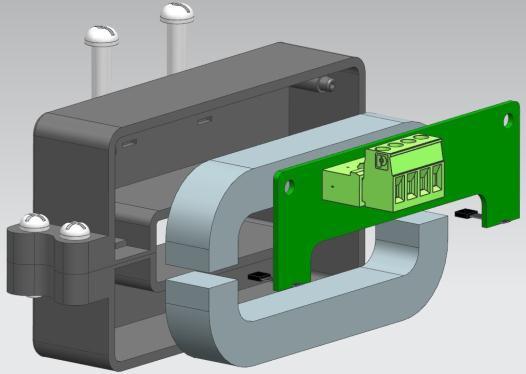
Current sensors can be divided into various types according to their operating principles and measurement ranges, including magnetic current sensors, Hall current sensors, resistive current sensors, capacitive current sensors, etc.
Magnetic current sensor is a common current sensor, based on Faraday’s law of electromagnetic induction, using the principle of magnetic field induction to measure current. It usually consists of a magnetic core, winding and circuit, etc. By passing the measured current into the core, a magnetic field is formed inside the core, and the induced electric potential in the winding is proportional to the current, which in turn outputs a voltage signal. Magnetic current sensors have the advantages of simple structure, fast response time and high accuracy, and are widely used for current measurement and protection in power systems.
Hall current sensor is another commonly used current sensor, based on the Hall effect principle to measure current. Hall current sensors use Hall elements in semiconductor materials to sense the relationship between potential and magnetic field, introduce the measured current into the Hall element, induce the potential signal and convert it into voltage or current output. Hall current sensors have the advantages of fast response time, high accuracy, and good linearity, and are commonly used for current measurement in electric vehicles, robots, power supplies, and other fields.
Resistive current sensors use the principle of generating a voltage in a resistor to measure current, with a simple and inexpensive structure, but lower accuracy and response speed, usually used for low-precision current measurement.
Capacitive current sensors use the change of current in capacitance to measure current, with fast response time and high accuracy, but higher price, usually used in high-precision current measurement and control fields.


