Thermistors
A thermistor is a thermal element based on the change in resistance with temperature. It is a resistor made of a special material whose resistance changes significantly with temperature. Thermistors are usually made of metal oxides or semiconductor materials. Common materials include zinc oxide and nickel oxide.
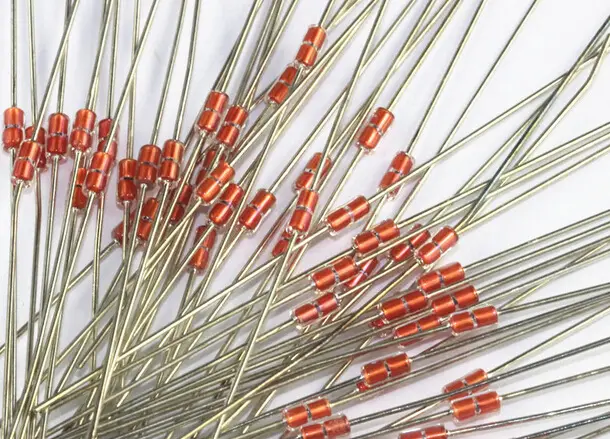
Working Principle: The resistance value of thermistor has a negative correlation with temperature, i.e., as the temperature rises, the resistance value decreases; a decrease in temperature increases the resistance value. This is due to the conductive properties of the thermistor material change with temperature. Different types of thermistors have different temperature characteristic curves, such as negative temperature coefficient and positive temperature coefficient.
NTC Thermistors: The resistance value of NTC thermistors decreases with increasing temperature. This type of thermistor is most common in the room temperature range and is often used in temperature measurement and control applications.NTC thermistors are characterized by high sensitivity and fast response time and are suitable for a wide range of temperature measurement and control scenarios.
PTC Thermistors: The resistance value of a PTC thermistor increases with temperature. This type of thermistor is commonly used for overcurrent protection and temperature control applications. When the temperature exceeds a specific threshold value of the PTC thermistor, the resistance value increases dramatically, thus limiting the passage of current. This characteristic allows the PTC thermistor to act as an automatic circuit breaker in a circuit.
Application areas: Thermistors are widely used in many fields. They are commonly used in applications such as temperature measurement, temperature control, overheating protection, circuit fault detection and temperature compensation. For example, in home appliances, automotive electronics, medical equipment, industrial automation and other fields, thermistors are used to measure and control temperature and protect circuits and equipment from overheating or overload damage.
The characteristic curve and resistance-temperature relationship of thermistors depend on their specific materials and manufacturing process. When selecting and using thermistors, it is necessary to understand their temperature characteristics, resistance range, accuracy requirements and environmental adaptability and other factors, and make a reasonable selection and design according to the specific application requirements.