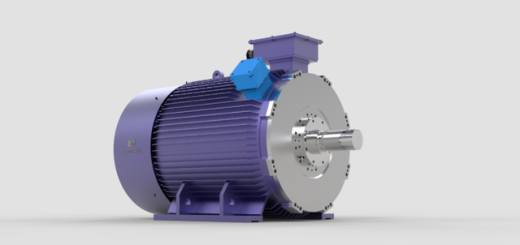
What Is Air-Gap Flux in a Motor?
Air gaps are one of the main issues in the design of electric motors. Electromagnetic devices have magnetic circuits that contain low-resistance materials (e.g., iron), which minimizes the amount of electrical energy required to produce a magnetic field. Gaps in magnetic circuits are usually unavoidable, they contain air, which provides a high resistance to magnetic flux, such gaps need to be detrimental in terms of magnetizing current and associated electrical losses.
An air gap is a non-magnetic part of a magnetic circuit which is usually connected in series with the rest of the circuit so that a large portion of the magnetic flux flows through the gap. Air gaps can be filled with non-magnetic materials such as gas, water, vacuum, plastic, wood, etc., not necessarily just air.
01 Effects of an air gap
The stator and rotor are the two main components of the motor, they are magnetically coupled and energy is transferred through the machine from both sides by means of a magnetic field, a small air gap can lead to low noise and a smaller unbalanced magnetic pull. Due to the increase in air gap magnetoresistance, the magnetic flux spreads into the surrounding medium, which can lead to flux fringing effect, which is an unwanted phenomenon that increases proximity and eddy current losses in conductors located near the air gap. The air gap causes a reduction in the magnetic chain between the rotor and stator and is seen as a loss. As the magnetic flux between the stator and rotor windings is reduced, thus weakening the transfer of magnetic energy, a large air gap means more magnetizing current and low power factor, the positive side of a large air gap has a better effect on the overload capacity of the motor.
The air gap may be an integral part of ensuring the correct performance of the equipment, it should be as small as possible, the form, shape and size of the air gap depends on the type and shape of the magnetic circuit, which is determined by the principle of operation, performance, size, efficiency and many other technical factors. In rotating machinery, where physical movement is required between the stator and rotor, an air gap is usually not required but is unavoidable, the minimum practical air gap for industrial machines being about 0.2 mm. In relays, the air gap is usually an integral part, contributing to the movement between the fixed parts (such as windings and cores) and the active armature, which mechanically actuates the connection or disconnection of the main electrical contacts. Air gaps are usually avoided in conventional transformers, which serve to instantaneously transfer energy from the primary winding to the secondary winding without the need for energy storage.
02 Air Gap in Electric Motors
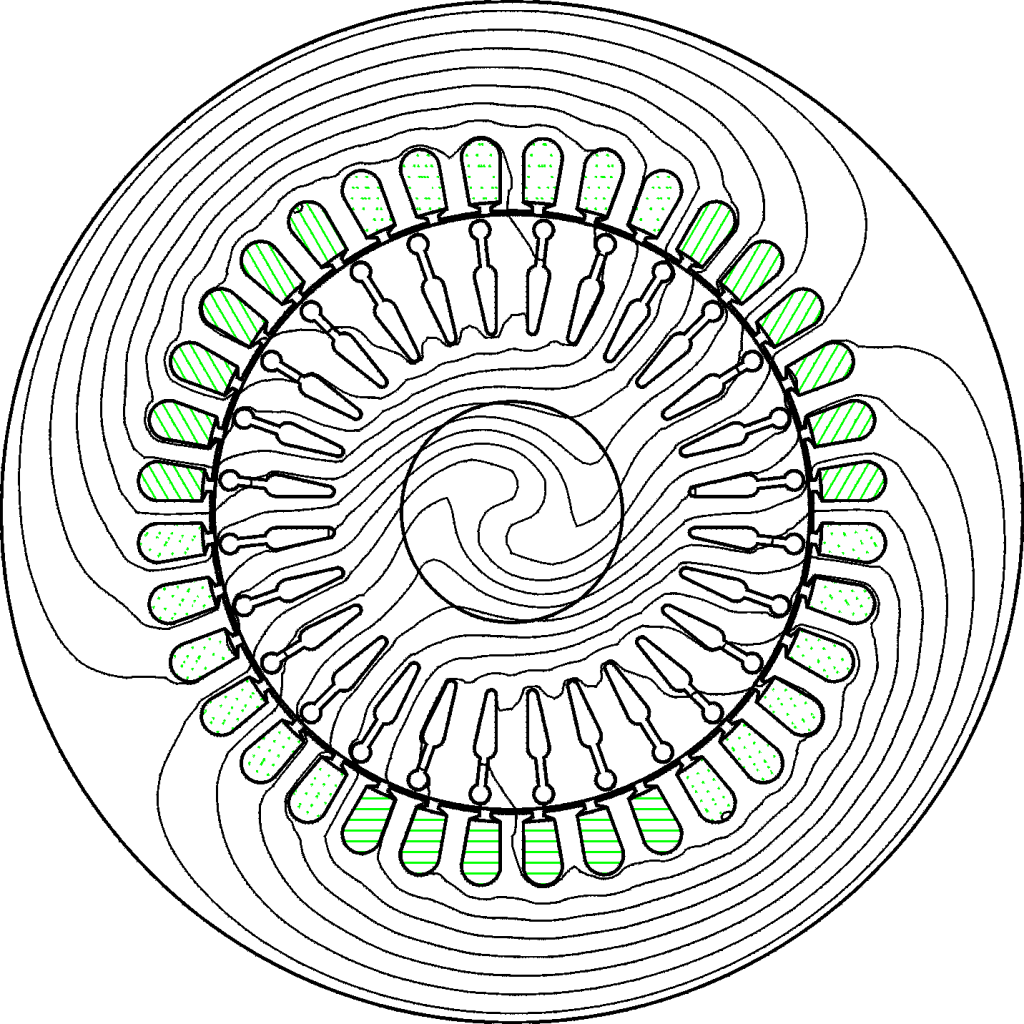
The air gap is the gap between the rotor and stator of a motor, a “free and open space” that physically separates the two motor parts. Since the rotor and stator are not magnetically coupled, there is an air gap between them. When properly supplied (depending on the type of machine), a magnetic field is established and connects the stator to the rotor. Because of the air gap, some portion of the magnetic field passes through either the rotor or the stator, but not both, and this portion of the magnetic flux is known as leakage flux, or air-gap flux (because it passes through the air gap alone). This leakage flux does not play a role in power transfer because it is not connected to either the stator or the rotor, and the current generated to establish the leakage flux causes the machine to lose power.
Both the stator and rotor are constructed of magnetic material (usually silicon steel), and the higher the permeability of the core medium, the lower the reluctance, and the lower the permeability of the air; the higher the reluctance, the longer the air gap, and the higher the leakage resulting in less power. Therefore, the air band length is kept as short as possible to allow separation between the rotor and stator and to provide the required mechanical balance of the machine. A free-spinning rotor is left with a gap of about 2 mm as a sacrificial magnetic loss so that the motor or generator can operate properly mechanically.
In synchronous and DC motors, two separate magnetic fields interact in the air gap, and the AC field generated by the armature (stationary in synchronous motors, rotating in DC motors) distorts the supply of the DC field, decreasing the efficiency and performance of the motor, Increasing the air gap reduces the effect of the “armature reaction”, and therefore the air gap of these machines will be less than that of an induction motor. Therefore, the air gap of these machines will be several times larger than that of an induction motor. In an induction motor, the electromotive force induced in the rotor windings is the mutual electromotive force. When the electromotive force induced in the rotor is generated by mutual induction, the induction motor can be regarded as a rotary transformer, and the larger the air gap, the larger the leakage flux and the smaller the mutual flux, which reduces the rotor electromotive force, current and torque.
In synchronous motors, the magnetic flux is set separately through the magnetic field windings and the electromotive force induced in the stator armature windings is not generated by mutual induction, but by dynamic induced electromotive force due to the relative motion between the magnetic field and the conductors, therefore, the air gap is not considered. For a convex pole motor, the air gap will be much larger in the region between the poles. The air gap required to separate the rotating rotor from the stator in a generator should be as small as possible to reduce the magnetizing power requirement, but should be large enough to prevent contact between the two, manufacturing tolerances in their dimensions, or movement due to mechanical deflection and loosening of the support bearings.
In any case, the gap must be large enough to ensure that the eccentricity of the rotor with respect to the stator does not cause the shaft stiffness to be affected by unbalanced magnetic tension, which could allow the rotor to strike the stator. Commonly used empirical calculations include rotor circumferential velocity, core length, and rotor diameter. Increasing the air gap increases the magnetizing current and also reduces stray load losses. Few design guidelines exist for selecting the air gap size best suited to any rotating machine, and for induction motors, practical values of 0.2 to 5 millimeters are typical for power ratings ranging from 3/4 to 750 kilowatts, with higher motor speeds resulting in larger gaps.