High-Voltage vs Low-Voltage Cables: Key Differences
High-voltage and low-voltage cables are distinguished according to the rated voltage to which the cables are subjected. Usually, cables rated at 1kV and below are called low-voltage cables, while cables rated at more than 1kV are called high-voltage cables.
There are also some differences between high-voltage and low-voltage cables in terms of construction and usage. Generally speaking, high-voltage cables are usually used in power transmission and distribution systems, which are subject to higher voltages and currents and require higher insulation and shock resistance, so their insulation materials and protective layers have to be more voltage resistant and protective accordingly.
High-voltage cables have many layers, from the inside to the outside, including: conductor, insulation, inner sheath, filling material (armor), outer insulation; low-voltage cables from the inside to the outside, respectively: conductor, insulation, steel tape, sheath (many low-voltage cables are not steel tape).
The main difference between high-voltage cables and low-voltage is that high-voltage cables have more semiconductor layers and shielding layers than low-voltage cables. Therefore, high-voltage cables than low-voltage cable insulation layer is much thicker, and the structure is complex, and the process requirements are high.
High-voltage cables are mainly used in the power sector for the transmission of electricity, substations voltage level change. We commonly used voltage levels are below 220KV, long-distance transmission of electricity voltage levels are ultra-high voltage, are designated by the power sector special power workers construction, special maintenance.
Low-voltage cables are suitable for electrical equipment with a voltage resistance of 450V/750V or less, and have a wide range of uses and many classifications. General industrial plastic insulated cable for fixed laying; mobile rubber low voltage insulated cable; building installation is mainly used for the laying of the main power circuit, each trunk branch, branch circuit, there are also special flat elevator cable for elevator installation.
Low-voltage cables can be produced using ordinary polyvinyl chloride and cross-linked polyethylene, and low-voltage cables have two kinds of ordinary and cross-linked. Only cross-linked cables are available for medium- and high-voltage cables. 6kV-35kV are produced using three-layer co-extruded, high-density cross-linked polyethylene.
High-voltage cables must be made according to a strict production process before the cable head can be used, while low-voltage cables are not mandatory to make the cable head. In addition, the laying requirements of high-voltage and low-voltage cables are different.
First of all, you can look at the structure. High-voltage cables have many layers, peel off the outermost layer inside and armor, shielding layer, insulation layer, conductors, etc.. Low-voltage cables generally set aside the outermost layer, which is the insulation layer or conductor.
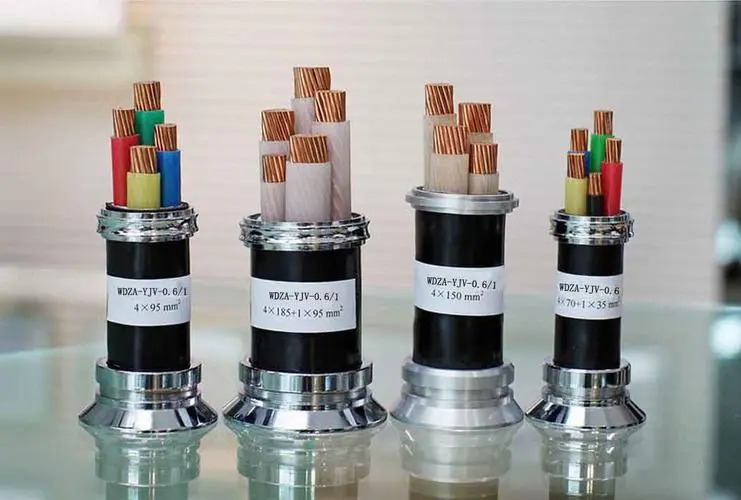
Second, high-voltage cable insulation layer is thicker, low-voltage cable insulation layer is thinner. Low-voltage cable insulation layer is generally within 3 mm, high-voltage cable insulation layer is generally more than 5 mm. Again, you can look at the outermost layer of the cable nameplate. The outermost layer of the cable is generally printed on the relevant parameters of the cable, which includes the cable model, cross-sectional area, rated voltage, length and other parameters.
Low-voltage cables are usually used in the home, industrial and commercial sectors, bearing relatively small voltages and currents, so their insulation materials and protective layer requirements are relatively low. The conductors of low-voltage cables are generally made of conventional conductive materials such as copper or aluminum, and the conductor cross-sectional area is smaller than that of high-voltage cables. The design and manufacture of low-voltage cables are also relatively simple and relatively low cost.
The difference between high-voltage cables and low-voltage cables lies mainly in the rated voltage and the use of the environment and the use of the difference, so in the selection and use of cables need to determine the appropriate type of cable according to the specific application requirements and standard regulations.